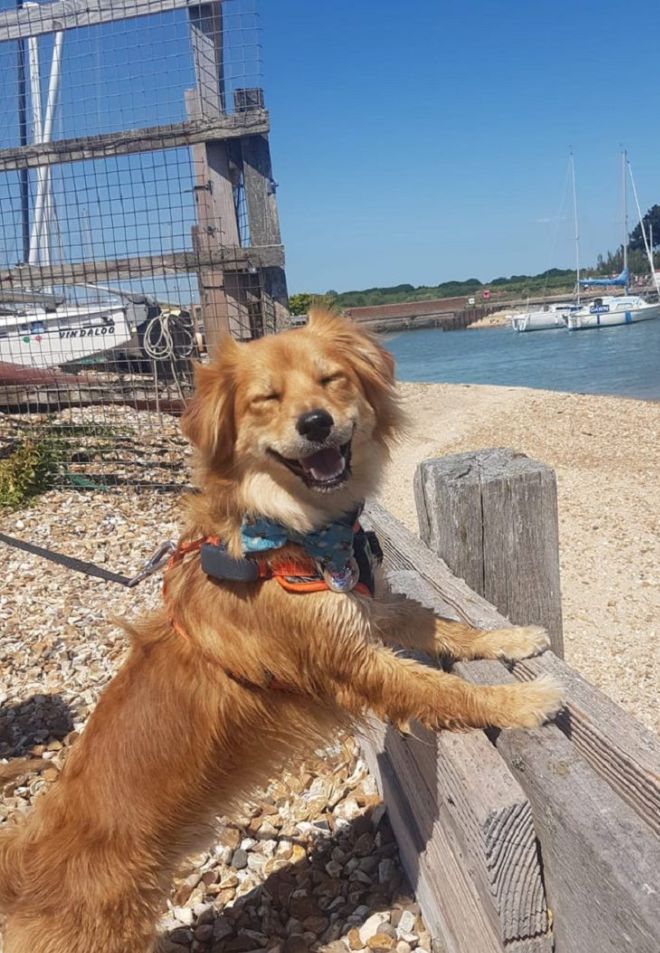

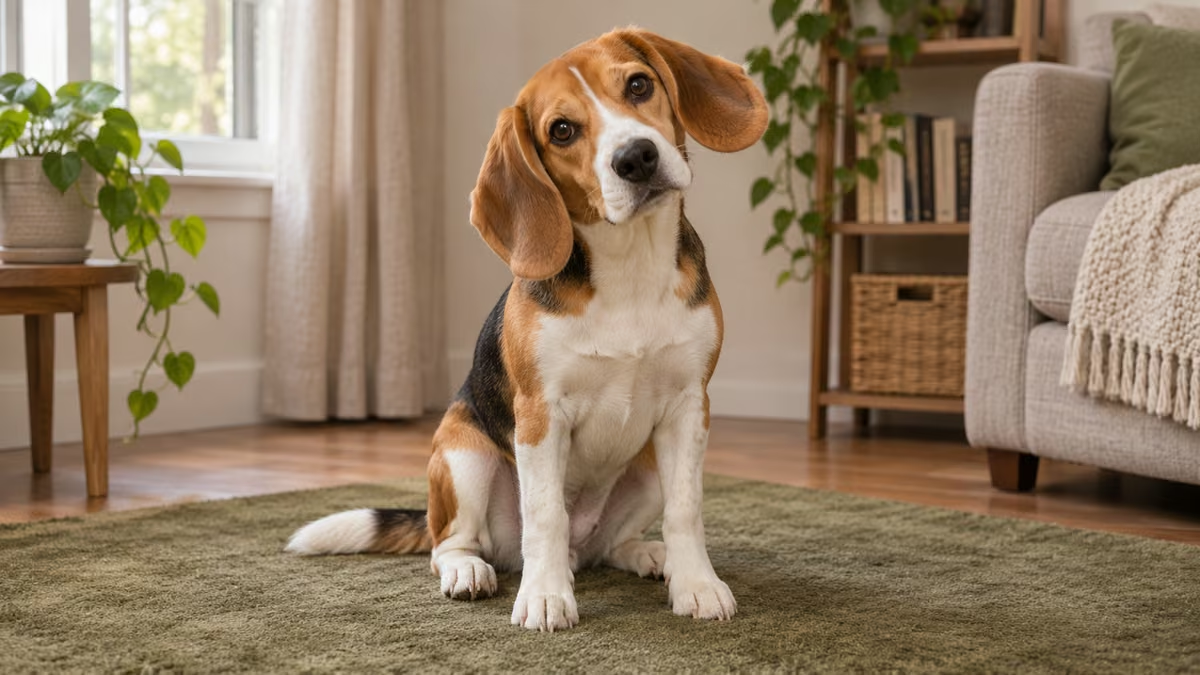
To catch your dog’s head tilt on camera, say a familiar word and watch their ears. Sometimes one perks up, the head tips to one side, and suddenly it looks as if you’ve asked the most interesting question in the world.
1. Listen for a familiar sound
Try watching for the tilt during an ordinary moment. Say the name of a favorite toy or make a familiar sound, then give your dog a moment to respond. Some dogs tilt their heads. Others look straight at you or go looking for the toy.
The best photos often come just after the tilt, when one ear is still up and the other has already flopped back down. Keep the camera at your dog’s eye level and let the moment happen on its own.
For more ideas on timing and framing, look through our Comedy Pet Photography Awards gallery or see how three Shibas turned a gap in a wall into a photo opportunity.
2. Set up for the head tilt on camera
Start near a window during the day. Sit on the floor so the camera is level with your dog’s eyes. If the window is behind your dog, move to the side until you can see the eyes clearly on your screen. Leave a little room on both sides of the frame so a floppy ear stays in the shot.
3. Take a short burst
Get the frame ready before you say the word. Tap the eye closest to you to set focus on your phone. If your camera has a burst mode, take a short sequence as your dog reacts. If you use an iPhone, Apple’s guide to Burst mode shows how to take a sequence and keep your favorite frames. Look through the frames afterward and pick the one where the eyes are sharp and the tilt feels natural.
If your dog walks away or loses interest, put the camera down and try again another day. A quiet moment at home will give you more chances than repeating the same sound over and over.
Choose a quiet background
Look behind your dog before you take the photo. A lamp growing out of the top of their head or a bright toy at the edge of the frame can pull attention away from their expression. Move a little to one side and see what drops out of the picture. A plain wall or the far end of a sofa is often all you need.
Watch the ears between shots
A head tilt can be quick enough that you miss it while looking at your screen. Once the frame is set, watch your dog directly and keep your finger near the shutter. If you are shooting with a phone, hold it in both hands and brace your elbows against your knees. This helps keep the frame steady while the dog moves.
Try a different angle if the first photo feels flat
Take one frame straight on and another from slightly to the side. In the second frame, the tilt may read more clearly because you can see the line from the nose to the nearer ear. Leave enough room around the muzzle and ears to crop later. A vertical frame works well for a close portrait, while a horizontal one can show where your dog is sitting.
Pick the frame with the clearest expression
Look through the burst at full size. Start with the eyes, then check whether the ears and nose are sharp enough for the image you want. A bit of movement at the tip of an ear can look natural if the eyes are clear. Compare two or three frames side by side before choosing one. The biggest tilt is rarely the only good shot.