
The next time you pass through a brick doorway, stop and look at the joints above it. In masonry arches, those lines often fan out instead of running parallel. They tell you how the opening can carry weight even though there is nothing directly beneath its center.
Follow the joints

Many masonry arches use wedge-shaped blocks, sometimes called voussoirs. As the arch carries weight, its blocks press against one another. In a brick arch, the wedge shape may come partly from the mortar joints. Look for joints that are narrower near the inside edge and wider toward the outside of the curve.
Look at the top, then at the sides

The keystone is the block at the crown of a traditional masonry arch. It closes the gap between the two sides. The blocks need support as the arch is built, which is why builders traditionally used temporary framing beneath the opening.
Once the arch is carrying weight, it pushes outward at the sides as well as downward. Look for thick walls or piers where the curve ends. Those supports matter just as much as the stone you see at the top. Yale’s guide to arch bridges explains the role of abutments and ties.
See what repetition does

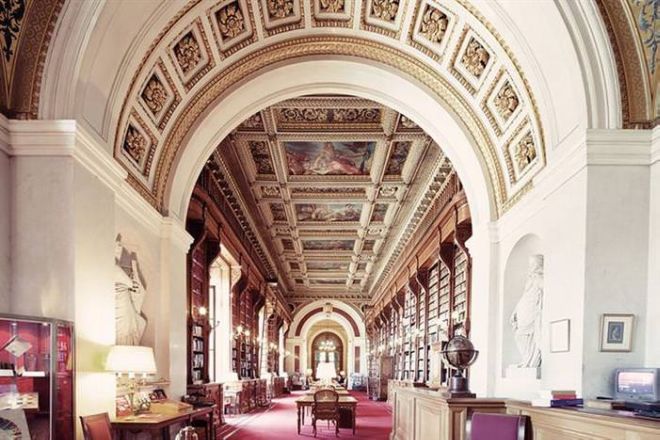
A row of arches draws your eye along a corridor. Stand near the middle and compare the openings. The nearest one frames the next, and the gaps between the supports give you a sense of distance. Modern buildings can use the same silhouette with different materials and construction, so the shape alone does not tell you how a building is supported.
A quick way to understand a masonry arch is to trace the curve down to the supports on either side. The shape draws the eye, but the piers carry the outward push.